
Play-Based Early Mathematics Does Not Start With Worksheets or Numbers on Paper
Updated: Jan 17
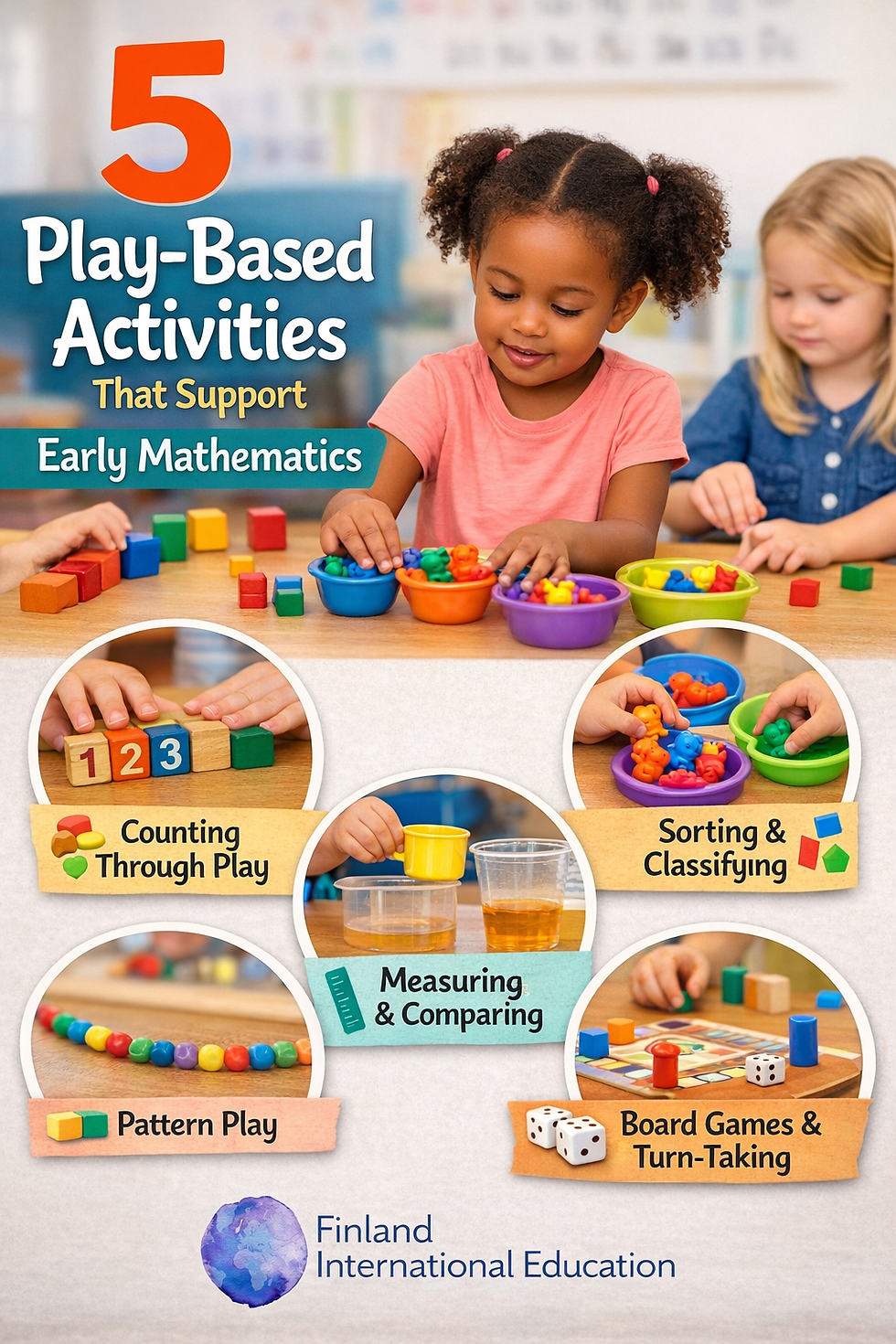
It starts with play. In early childhood education, mathematics develops naturally when children explore, compare, sort, and make sense of the world around them. Here are five simple play-based early mathematics activities that support early mathematical skills in a joyful and developmentally appropriate way.
1 Counting Through Play
Use everyday objects such as blocks, stones, buttons, or toys.Children learn counting, one-to-one correspondence, and quantity by touching and moving objects while counting aloud.
Key skills: numbers, quantity, basic addition
2️ Sorting and Classifying
Invite children to sort objects by color, size, shape, or material.This strengthens logical thinking and helps children recognize similarities and differences.
Key skills: categorization, comparison, early logic
3️ Pattern Play
Create simple patterns using colors, shapes, sounds, or movements (e.g. clap–jump–clap–jump). Patterns are a foundation for mathematical reasoning and problem-solving.
Key skills: sequencing, prediction, reasoning
4️ Measuring in Everyday Life
Compare lengths, weights, or volumes using cups, spoons, strings, or containers. No numbers needed at first. Children learn concepts like more, less, longer, shorter.
Key skills: measurement, estimation, spatial understanding
5️ Board Games and Turn-Taking Games
Simple board games introduce counting, numbers, rules, and turn-taking in a social context.
Key skills: number recognition, counting forward, logical thinking
Why Play-Based Early Mathematics Matters
When mathematics is embedded in play, children:
build confidence
develop positive attitudes toward learning
understand concepts deeply instead of memorizing
This approach reflects Finnish early childhood pedagogy, where learning is meaningful, joyful, and child-centred.
Explore educational toys inspired by Finnish early childhood education finedushop.store
At Fineducation, we believe that strong learning foundations are built through play, curiosity, and wellbeing.
Across cultures and contexts, children learn best when learning feels joyful and safe.
We are committed to sharing play-based, child-centred educational thinking responsibly and respectfully always with children’s wellbeing at the heart.
– The Fineducation Team

Comments